

Preparing for NIMCET 2027 requires a clear study plan, consistent practice and a strong understanding of the examination pattern. Since NIMCET is the entrance examination for admission to MCA programmes at participating NITs and other participating institutes, candidates need to prepare strategically to achieve a competitive rank.
The most important part of NIMCET preparation is Mathematics, which carried 600 out of 1,000 marks in the 2026 examination. However, Logical Reasoning, Computer Awareness and General English also contribute to the final score and should not be ignored.
Whether you are a BCA student, a BSc graduate or preparing for the examination from scratch, following the right NIMCET 2027 preparation strategy can help you manage your time, strengthen your concepts and improve your performance.
In this guide, we will explain how to prepare for NIMCET 2027, which subjects to prioritise, how to create a daily timetable, when to start solving previous-year question papers and how to use mock tests effectively.
What Is the Best NIMCET 2027 Preparation Strategy?
The best NIMCET 2027 preparation strategy is to prioritise Mathematics, complete the official syllabus, practise questions regularly, solve previous-year papers and take timed mock tests.
Candidates should follow these seven steps:
- Understand the latest available NIMCET exam pattern and syllabus.
- Strengthen basic Mathematics concepts before moving to advanced questions.
- Prepare all four examination subjects systematically.
- Create a realistic daily and weekly study timetable.
- Practise previous-year question papers topic-wise.
- Take regular mock tests and analyse mistakes.
- Revise formulas, concepts and important questions consistently.
Starting early is beneficial, but consistency and effective preparation are more important than simply studying for long hours.
Understand the NIMCET 2027 Exam Pattern Before Preparing
Before starting your preparation, understand how the examination is structured. The latest officially available pattern is the NIMCET 2026 pattern. The NIMCET 2027 information brochure has not yet been released, so candidates should verify the pattern when the official notification becomes available.
According to the 2026 examination pattern, the test consisted of 120 multiple-choice questions carrying 1,000 marks.
| Subject | Questions | Marks per Question | Total Marks |
| Mathematics | 50 | 12 | 600 |
| Analytical Ability & Logical Reasoning | 40 | 6 | 240 |
| Computer Awareness | 20 | 6 | 120 |
| General English | 10 | 4 | 40 |
| Total | 120 | — | 1,000 |
NIMCET 2026 Marking Scheme
- Correct Mathematics answer: +12 marks
- Incorrect Mathematics answer: -3 marks
- Correct Reasoning answer: +6 marks
- Incorrect Reasoning answer: -1.5 marks
- Correct Computer Awareness answer: +6 marks
- Incorrect Computer Awareness answer: -1.5 marks
- Correct English answer: +4 marks
- Incorrect English answer: -1 mark
The examination was conducted in three timed parts:
- Mathematics: 70 minutes
- Analytical Ability and Logical Reasoning: 30 minutes
- Computer Awareness and General English: 20 minutes
Candidates could not move back to an earlier part after its allotted time ended. This makes time management and question selection important preparation skills.
Important: These details are based on the official NIMCET 2026 information brochure. Candidates should check the official NIMCET website for any changes in the 2027 examination pattern.
Subject-Wise NIMCET 2027 Preparation Strategy
A subject-wise preparation strategy helps candidates divide their syllabus into manageable sections and identify the topics that require more attention.
1. Mathematics Preparation Strategy
Mathematics is the most important subject in NIMCET because it carries 60% of the total marks under the 2026 pattern.
Candidates should spend a significant portion of their preparation time understanding mathematical concepts and practising different types of questions.
Important Mathematics topics include:
- Algebra
- Calculus
- Coordinate Geometry
- Trigonometry
- Probability and Statistics
- Set Theory and Logic
How to prepare Mathematics for NIMCET 2027:
- Build your fundamentals: Start with basic concepts, formulas and mathematical operations. Do not jump directly into difficult questions without understanding the fundamentals.
- Follow topic-wise preparation: Complete one topic at a time. Study the concepts, understand solved examples and then practise questions independently.
- Maintain a formula notebook: Write down important formulas, identities, theorems and shortcuts. Revise them regularly.
- Practise numerical problems daily: Mathematics requires regular problem-solving. Try to solve questions without depending on calculators.
- Solve previous-year questions: Once you complete a topic, practise related NIMCET previous-year questions to understand the question patterns.
- Improve calculation speed: Practise mental calculations, simplification and time-based problem-solving.
Tip: Mathematics should be included in your daily timetable, even when you are preparing other subjects.
2. Analytical Ability and Logical Reasoning Preparation Strategy
Analytical Ability and Logical Reasoning tests a candidate’s ability to understand information, identify patterns and solve problems logically.
Under the 2026 pattern, this section carried 240 marks and included 40 questions.
Important topics include:
- Coding and Decoding
- Blood Relations
- Direction Sense
- Seating Arrangements
- Number and Alphabet Series
- Syllogisms
- Data Interpretation
- Logical Puzzles
- Statement and Conclusion
- Analytical Reasoning
How to prepare Logical Reasoning:
- Start with basic reasoning concepts and understand the methods used to solve different question types.
- Practise 15–20 questions daily, gradually increasing the difficulty.
- Solve puzzles and arrangement-based questions using diagrams and tables.
- Practise timed question sets to improve speed.
- Review incorrect answers and understand why a particular approach did not work.
Tip: Focus on accuracy first and then increase your solving speed. Spending too much time on one difficult puzzle can affect your overall performance.
3. Computer Awareness Preparation Strategy
Computer Awareness is another important section of NIMCET. Candidates with a BCA or computer science background may already understand some concepts, but they should still revise the complete syllabus.
Under the 2026 pattern, this section included 20 questions carrying 120 marks.
Important Computer Awareness topics include:
- Computer Fundamentals
- Computer Organisation
- Input and Output Devices
- Computer Memory
- Number Systems
- Binary and Hexadecimal Systems
- Boolean Algebra
- Operating Systems
- Software and Hardware
- Internet and Email
How to prepare Computer Awareness:
- Understand basic computer concepts instead of memorising definitions without context.
- Prepare short notes for important topics.
- Practise number system conversions and binary arithmetic.
- Revise computer hardware, software and operating system fundamentals.
- Solve topic-wise MCQs after completing each chapter.
- Revise important definitions and concepts every week.
Tip: Prepare short revision notes for factual topics so you can revise them quickly before the examination.
4. General English Preparation Strategy
Although General English carries fewer marks than Mathematics and Logical Reasoning, candidates should not ignore this section.
The 2026 examination included 10 English questions carrying 40 marks.
Important English topics include:
- Reading Comprehension
- Vocabulary
- Synonyms and Antonyms
- Grammar
- Sentence Correction
- Word Usage
- Basic English Language Skills
How to prepare General English:
- Read English newspapers, articles or editorials regularly.
- Learn new vocabulary and understand how words are used in sentences.
- Practise grammar and sentence correction questions.
- Solve reading comprehension passages within a time limit.
- Revise synonyms, antonyms and commonly confused words.
Tip: Spend 15–20 minutes daily on English rather than trying to complete the entire subject in the final weeks.
NIMCET 2027 Six-Month Preparation Strategy
A six-month preparation plan can help candidates complete the syllabus, practise questions and revise important concepts before the examination.
The following roadmap is a suggested preparation schedule, not an official examination calendar.
| Month | Preparation Focus | What to Complete |
| Month 1 | Build fundamentals | Basic Mathematics, Algebra and Computer Fundamentals |
| Month 2 | Complete core concepts | Calculus, Coordinate Geometry and Logical Reasoning |
| Month 3 | Expand syllabus coverage | Probability, Statistics, Trigonometry and Computer Awareness |
| Month 4 | Practice and PYQs | Topic-wise tests, previous-year questions and English |
| Month 5 | Mock tests and revision | Full-length mocks, weak topics and formula revision |
| Month 6 | Final preparation | Mock analysis, revision, accuracy and time management |
Month 1: Strengthen Your Fundamentals
Begin by understanding the basic concepts of Mathematics. Focus on algebraic operations, equations, number systems and other foundational topics.
Alongside Mathematics, start learning computer fundamentals and practise basic logical reasoning questions.
Monthly target: Develop a strong foundation and establish a consistent study routine.
Month 2: Complete Important Mathematics Topics
Once your fundamentals are clear, move towards more advanced Mathematics topics such as Calculus and Coordinate Geometry.
Continue practising Logical Reasoning and begin solving topic-wise questions under time limits.
Monthly target: Improve conceptual understanding and start timed practice.
Month 3: Cover Remaining Subjects
Focus on Probability, Statistics, Trigonometry and other remaining Mathematics topics.
Complete the major areas of Computer Awareness and continue English vocabulary and grammar practice.
Monthly target: Complete most of the syllabus and identify weak areas.
Month 4: Start Intensive Question Practice
Now shift your attention towards previous-year question papers and topic-wise tests.
Identify frequently misunderstood concepts and practise questions from different difficulty levels.
Monthly target: Improve accuracy and understand the examination’s question patterns.
Month 5: Focus on Mock Tests
Start taking full-length mock tests regularly. Analyse your performance after every test.
Pay attention to incorrect answers, unanswered questions and topics where you spend too much time.
Monthly target: Improve speed, accuracy and time management.
Month 6: Revise and Strengthen Preparation
Avoid starting too many new topics during the final month.
Revise formulas, important concepts, short notes and previously incorrect questions. Continue taking timed tests based on the latest official examination structure.
Monthly target: Improve confidence and enter the examination with a clear strategy.
NIMCET 2027 Daily Study Timetable
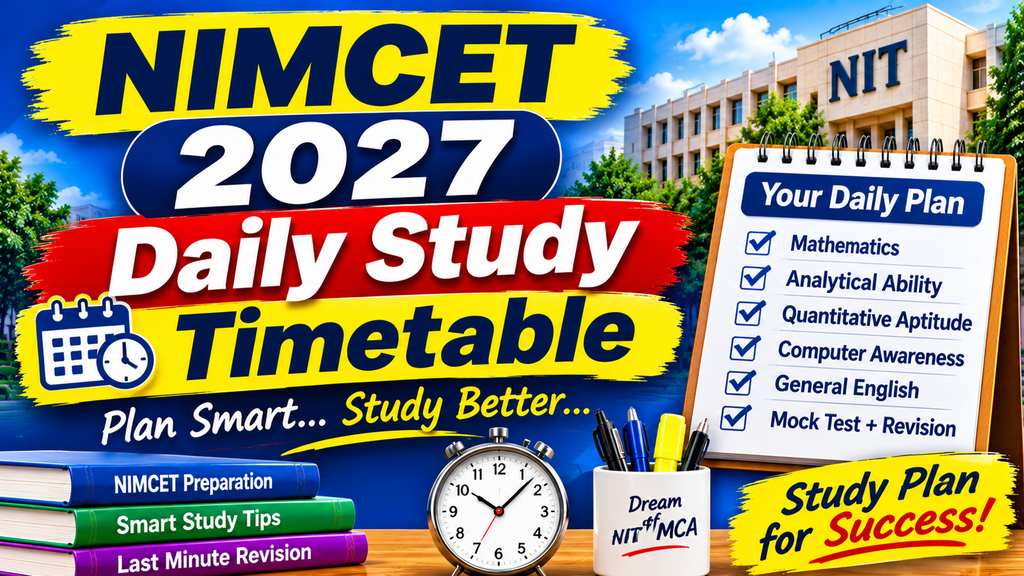
Following a daily timetable helps candidates maintain consistency and complete the syllabus within the available time.
Here is a suggested six-hour daily study schedule.
| Time | Subject | Activity |
| 7:00 AM – 9:00 AM | Mathematics | Concepts and problem-solving |
| 9:00 AM – 9:30 AM | Break | Rest |
| 9:30 AM – 10:30 AM | Logical Reasoning | Practice questions |
| 10:30 AM – 11:30 AM | Computer Awareness | Theory and MCQs |
| 4:00 PM – 5:00 PM | Mathematics | Topic-wise question practice |
| 5:00 PM – 5:30 PM | English | Grammar and vocabulary |
| 8:00 PM – 8:30 PM | Revision | Review formulas and mistakes |
Candidates attending college or working alongside preparation can adjust the timetable according to their availability.
The most important thing is to maintain daily Mathematics practice and give sufficient attention to the remaining subjects.
How to Prepare for NIMCET 2027 from Scratch?
Candidates who are starting NIMCET preparation from scratch should avoid trying to complete the entire syllabus immediately.
Instead, follow a step-by-step approach.
Step 1: Understand the examination
Read the latest available NIMCET information brochure and understand the examination pattern, marking scheme and syllabus.
Step 2: Evaluate your current preparation level
Attempt a basic diagnostic test to identify your strengths and weaknesses, especially in Mathematics.
Step 3: Start with basic concepts
Build your fundamentals before attempting advanced questions. Give additional time to topics that you find difficult.
Step 4: Prepare one subject at a time
Divide each subject into smaller topics and set weekly completion targets.
Step 5: Practise questions regularly
Solve topic-wise MCQs and previous-year questions after completing each topic.
Step 6: Start taking mock tests
Once you have covered a reasonable portion of the syllabus, introduce timed sectional tests and full-length mocks.
Step 7: Revise consistently
Maintain short notes and an error notebook to track concepts and questions that need additional practice.
Importance of Previous-Year Question Papers for NIMCET 2027
Previous-year question papers are important because they help candidates understand the examination format and evaluate their preparation.
Solving NIMCET previous-year question papers can help you:
- Understand the types of questions asked.
- Identify important syllabus topics.
- Improve problem-solving speed.
- Practise time management.
- Evaluate subject-wise preparation.
- Identify recurring mistakes.
How should you use previous-year papers?
Start with topic-wise questions after completing individual chapters. Once you have covered most of the syllabus, attempt complete papers under timed conditions.
After completing each paper, analyse incorrect answers and revisit the concepts behind them.
Do not simply solve a question paper and check your marks. Understanding your mistakes is an equally important part of preparation.
How to Use Mock Tests to Improve Your NIMCET Rank?
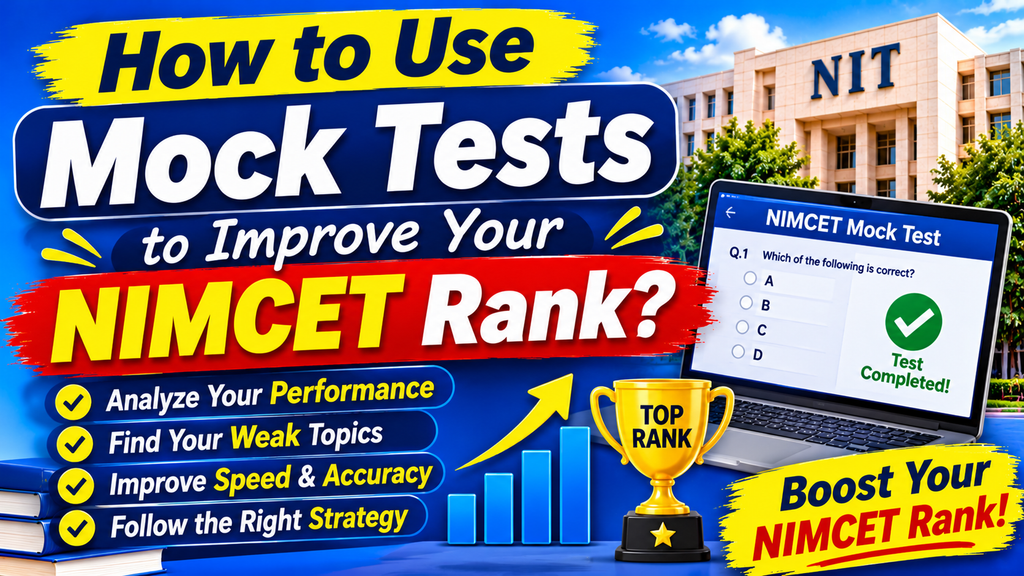
Mock tests help candidates understand how effectively they can apply their knowledge under examination conditions.
However, taking multiple mock tests without analysing the results may not improve performance significantly.
Follow these steps after every mock test:
- Calculate your overall score and subject-wise performance.
- Identify the questions answered incorrectly.
- Check which questions consumed more time than expected.
- Identify topics where you repeatedly make mistakes.
- Revise the concepts behind incorrect answers.
- Set improvement targets for your next mock test.
Candidates should also practise the three examination parts separately according to the latest available pattern.
Remember that negative marking makes accuracy important. Attempting every question without understanding it can reduce your final score.
Common Mistakes to Avoid During NIMCET 2027 Preparation
Many candidates spend considerable time studying but fail to follow an effective preparation strategy.
Avoid these common mistakes:
1. Ignoring Mathematics: Mathematics carries the highest weightage, so postponing its preparation can create serious difficulties.
2. Studying without a timetable: Random preparation makes it difficult to track syllabus completion and revision.
3. Ignoring smaller subjects: Computer Awareness and English also contribute to the total score.
4. Solving questions without understanding concepts: Memorising solutions does not develop the problem-solving ability needed for the examination.
5. Avoiding mock tests: Candidates need timed practice to become comfortable with the examination structure.
6. Ignoring negative marking: Unnecessary guessing can reduce the final score.
7. Not revising completed topics: Regular revision is necessary to retain formulas, concepts and important information.
Final Tips to Crack NIMCET 2027
If you want to improve your chances of securing a good NIMCET rank, follow these preparation tips:
- Follow the latest official syllabus.
- Give Mathematics priority in your daily schedule.
- Practise Logical Reasoning regularly.
- Revise Computer Awareness concepts.
- Improve English vocabulary and comprehension.
- Solve previous-year question papers.
- Take mock tests under timed conditions.
- Analyse mistakes after every test.
- Maintain short notes for quick revision.
- Stay consistent throughout your preparation.
Remember, cracking NIMCET is not only about studying for long hours. It is about understanding concepts, practising consistently, improving accuracy and managing time effectively.
Frequently Asked Questions About NIMCET 2027 Preparation
1. How should I start preparing for NIMCET 2027?
Start by understanding the latest available syllabus and examination pattern. Strengthen your Mathematics fundamentals, prepare all four subjects, solve topic-wise questions and gradually introduce mock tests.
2. How many months are required to prepare for NIMCET 2027?
The preparation time depends on your existing knowledge and daily study hours. A six-month structured plan can provide a useful preparation framework, while students with weaker fundamentals may benefit from starting earlier.
3. Which subject should I focus on most for NIMCET 2027?
Mathematics should receive the highest priority because it carried 600 out of 1,000 marks in the 2026 examination. However, Logical Reasoning, Computer Awareness and English should also be prepared.
4. Can I crack NIMCET 2027 with six months of preparation?
Yes, six months can be sufficient for focused preparation, depending on your starting level, syllabus coverage and daily study routine. Follow a structured timetable and regularly evaluate your progress through mock tests.
5. Are NIMCET previous-year question papers important?
Yes. Previous-year question papers help candidates understand question patterns, practise time management, identify weak topics and evaluate their preparation.
6. How many hours should I study daily for NIMCET 2027?
There is no fixed number of hours for every candidate. A consistent schedule of approximately 5–6 focused study hours can be a useful starting point, depending on your academic background and preparation level.
7. Is Mathematics compulsory for NIMCET preparation?
Mathematics is a major component of the examination and carried 60% of the marks in 2026. Candidates should check the official eligibility criteria and syllabus to understand the academic and subject requirements.
8. Is NIMCET 2027 difficult to crack?
NIMCET can be challenging because of its Mathematics weightage, time restrictions, negative marking and competition. A structured study plan, regular practice and proper revision can help candidates prepare effectively.
9. When should I start taking NIMCET mock tests?
Start with sectional tests after completing the fundamentals of individual subjects. Begin full-length mock tests once you have covered a substantial portion of the syllabus, and increase their frequency as the examination approaches.
10. What is the best way to improve accuracy in NIMCET?
Practise topic-wise questions, avoid unnecessary guessing, analyse incorrect answers and take timed mock tests. Maintaining an error notebook can help identify and correct repeated mistakes.
Start Your NIMCET 2027 Preparation with InfoMaths
Preparing for NIMCET requires the right combination of conceptual clarity, regular practice and effective time management.
At InfoMaths, candidates can strengthen their preparation with subject-wise learning, practice questions, previous-year question papers and mock-test preparation resources.
Start with the fundamentals, follow a consistent study plan and work towards improving your performance every week.
Your NIMCET 2027 preparation starts with the right strategy.